



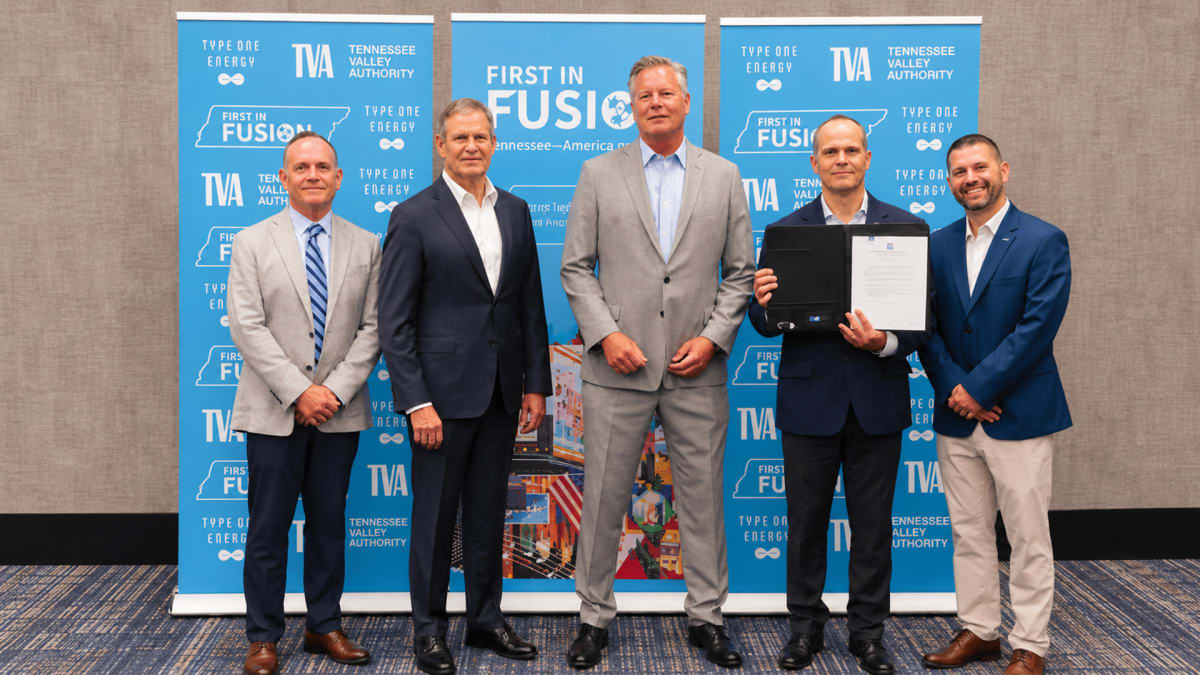
A Fusion First for Tennessee
Tennessee has never been shy about making power. Now it has become the first state to hand commercial fusion its own regulatory key, and Knoxville has the address where the experiment gets real.
On August 31, the Tennessee Department of Environment and Conservation announced a fusion-specific byproduct material license for Knoxville-based Type One Energy. It is the first license issued by any state under a new framework designed specifically for nuclear fusion machines, rather than squeezing an emerging technology into rules built for something else.
That distinction is more than bureaucratic housekeeping. Fusion combines light atomic nuclei and releases energy, the same basic process that powers stars. Commercializing it, however, requires more than clever physics and a very confident rendering. Companies also need clear safety rules, specialized workers, utilities, researchers, and patient capital. Tennessee is trying to put those pieces within driving distance of one another.
From Bull Run to a Business Cluster
Type One Energy intends to break ground this year on the first phase of Project Infinity at the Tennessee Valley Authority’s Bull Run Energy Complex in Clinton. Full startup is expected by 2034. The planned commercial site would operate as a fusion development campus, linking the company with Oak Ridge National Laboratory, TVA, and the University of Tennessee.
That roster explains why this matters beyond one permit. East Tennessee already has deep nuclear knowledge and energy infrastructure. A defined licensing path gives fusion companies another practical reason to look here when choosing where to hire, test, build, and invest. For local businesses, the opportunity could reach engineering, advanced manufacturing, construction, technical services, and workforce development, though the scale depends on how Project Infinity advances.
Big Number, Careful Wording
Type One Energy forecasts Infinity Two as a 400-megawatt-electric fusion power plant using stellarator technology. “Forecasts” is doing honest work in that sentence. The plant is planned, the license is real, and commercial fusion remains an undertaking with a long runway.
Still, regulatory firsts count in business because uncertainty costs money. Tennessee has now shown companies what a state-level fusion licensing process can look like. That may be less cinematic than bottling a star, but it is how industries move from whiteboards toward payrolls.
For Tennesseans, the bigger story is the chance to turn the state’s existing nuclear expertise into a durable commercial ecosystem, with Knoxville, Clinton, and Oak Ridge positioned close to the center.
Find more Tennessee manufacturers and industry resources in the Guide to Tennessee manufacturing directory: https://www.guidetotennessee.com/manufacturing.
